

You must hold your quiet center,
where you do what only you can do.
—Ha Jin, from “A Center”
In a for-profit firm, the decision to do something in-house or hire outside support is a matter of competitive advantage. But nonprofit arts organizations, especially small to medium ones, face a more confusing calculus. When should an arts nonprofit retain or build internal capacity, and when should it outsource? And how does Generative AI change that game?
Pope et al (2015) identify three benefits to outsourcing rather than doing something in-house. In a nutshell, outsourcing “allows an organization to focus, receive external expertise, and reduce costs.”
Focus - Outsourcing a non-core activity lets organizations focus energy and attention on their core. Core activities are ‘‘those traditionally performed in-house, those critical to business performance, those that create current or potential competitive advantage, as well as activities that will drive further growth, innovation or rejuvenation’’ (Kakabadse and Kakabadse 2000, p. 674). Non-core is everything else.
External Expertise - No organization (especially no small or medium organization) can maintain internal expertise on every aspect of the business. Outsourcing allows a firm to hire such expertise by the hour or by the project (I’ve written before about outsourcing expertise).
Reduced Costs - Outsourcing can also provide superior technical resources at lower costs than building or running something yourself.
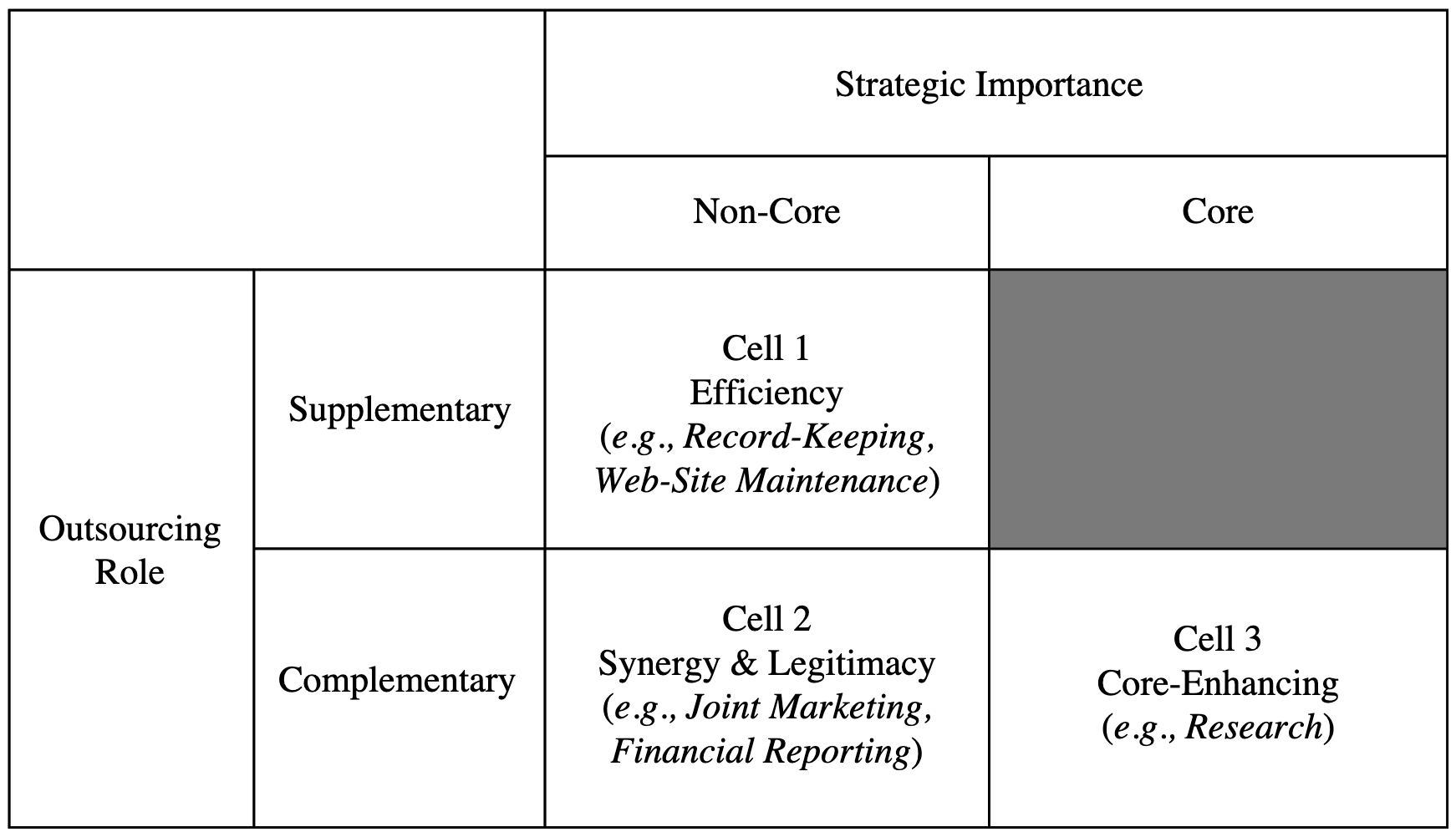
To focus decision-making, Elango (2008) distinguishes between “supplementary” and “complementary” outsourcing.
Supplementary outsourcing replaces completely one or more of the firm’s activities (for example, a cleaning or custodial service without an internal facilities manager).
Complementary outsourcing enhances the work of the in-house team (for example, a market analytics service supporting an in-house marketing team) .
Elango suggests a strategic matrix at the intersection of core/non-core and supplementary/complementary. One quadrant is grayed out, since completely outsourcing a core activity would be self-sabotage (giving away the farm).
Outsourcing decisions are more cloudy for small and medium nonprofit arts organizations for a range of reasons. For one, nonprofits are judged harshly for “overhead” spending – even when that expense amplifies their mission. For another, small and medium nonprofits are generally under-resourced and unable to afford outside services – even when they make strategic and financial sense.
But the rising accessibility and affordability of generative AI is changing the math at every scale of the nonprofit arts. GenAI systems essentially offer outsourced cognitive and technical labor at little to no cost to the user.1 Which brings outsourcing decisions into every enterprise of every size.
When deciding whether or when to use generative AI systems in your arts venture, the “outsourcing matrix” can be a good place to start. Consider efficiency when supplementing non-core activities. Look for synergy or core-enhancement in complementary uses of the technologies. And never, ever fully outsource your core activities or competencies to outside firms or pattern-matching language bots.
Which raises the rather essential question: What activities or competencies are the essence of what you offer? And how are you defending and developing them in this new world?
From the ArtsManaged Field Guide
Function of the Week: People Operations
People Operations involves designing and driving systems and practices that attract, engage, retain, and develop people within the enterprise (also called human resources).
Framework of the Week: Core Mission Support
Core Mission Support redefines “overhead” expenses as essential for nonprofit success, highlighting that strong finance, HR, and governance are crucial for achieving mission goals. This view argues that overhead is not a distraction but a necessary foundation for impactful programs and services.
Photo by Ryoji Iwata on Unsplash
Sources
Elango, B. 2008. “Using Outsourcing for Strategic Competitiveness in Small and Medium-Sized Firms.” Competitiveness Review (Bingley) 18 (4): 322–32.
Kakabadse, Nada, and Andrew Kakabadse. 2000. “Critical Review - Outsourcing: A Paradigm Shift.” The Journal of Management Development (Bradford) 19 (8): 670–728.
Pope, Jennifer A., Ashima Saigal, and Katherine A. Key. 2015. “Do Small Nonprofit Organizations Outsource?: A First Look.” Voluntas (Manchester, England) (New York) 26 (2): 553–73.
The true, total, and collective societal costs of these technologies are astronomical and rising exponentally.